
Breed standard: Rough Collie
Breed standard: Rough Collie (kennelliitto.fi, in Finnish)
ROUGH COLLIE (COLLIE, ROUGH)
Country of origin: Great Britain
Group: 1
FCI number: 156
Approved: FCI 22.11.2012
Finnish Kennel Club 11.12.2012
UTILIZATION
Herding dog
FCI CLASSIFICATION
Group 1 Sheepdogs and Cattledogs (except Swiss Cattledogs)
Section 1 Sheepdogs. Without working trial.
BRIEF HISTORICAL SUMMARY
The Rough and Smooth Collie are alike except for the length of the coat. The breed is believed to have developed when dogs originally brought to Scotland by the Romans were crossed with the region's native dogs. Devotees of the breed sometimes point to subtle differences between the two breeds that have arisen from the breeding choices of individual breeders. In fact the two breeds separated from the same lines only fairly recently, and in reality they still share lines behind them. The Rough Collie is a slightly more refined version of the original dogs of the Scottish shepherds and has been bred for at least a hundred years. Many of today's dogs are also able to work when given the chance. Besides its beauty, the collie is a working dog.
GENERAL APPEARANCE
A dog of great beauty, with every part in harmony with the whole. Stands with impassive dignity. Its structure shows strength and activity. Neither clumsy nor in any way coarse. Expression is of great importance. Other essential features are the correct proportion of skull and muzzle and perfect balance, the size, shape, colour and placement of the eyes, and the correct set and carriage of the ears.
BEHAVIOUR / TEMPERAMENT
Friendly, never nervous or aggressive. An excellent companion dog – friendly, happy and active, and gets on well with children and other dogs.
HEAD
Proportions are very important; the head must be judged in relation to the size of the dog. Seen from the front or the side, the head resembles a blunt, clean-cut wedge with smooth outlines. The head tapers gradually and smoothly from the ears towards the black nose, without flaring at the sides. Seen from the side, the top lines of skull and muzzle are parallel and of equal length, separated by the stop. The midpoint between the inner corners of the eyes (the correct position of the stop) is the centre of the head lengthwise. The depth of the skull from the brows to the underside of the jaw is never excessive (i.e. not deep throughout).
Skull: Flat.
Stop: Slight but perceptible.
Nose: Always black.
Muzzle: The smooth, well-rounded muzzle ends bluntly, never square. The muzzle is not pointed.
Jaws / teeth: Strong jaws with a well-defined underjaw. Teeth of good size. A regular and complete scissor bite, i.e. the lower incisors closely touch the back of the upper incisors. The teeth are set square to the jaws.
Cheeks: Cheekbones not prominent.
Eyes: A sweet expression is very important to the breed. The eyes are medium-sized (never very small), set somewhat obliquely, almond-shaped and dark brown, except in blue merles, whose eyes are often blue or blue-flecked (partly or completely, one or both). The expression is full of intelligence, with a quick, alert look when the dog is listening.
Ears: The small ears are set on top of the head, neither too close together nor too far apart. At rest the dog may carry its ears thrown back, but when alert they are brought forward and carried semi-erect, i.e. about two thirds of the ear is erect and the top third tips forward and down naturally.
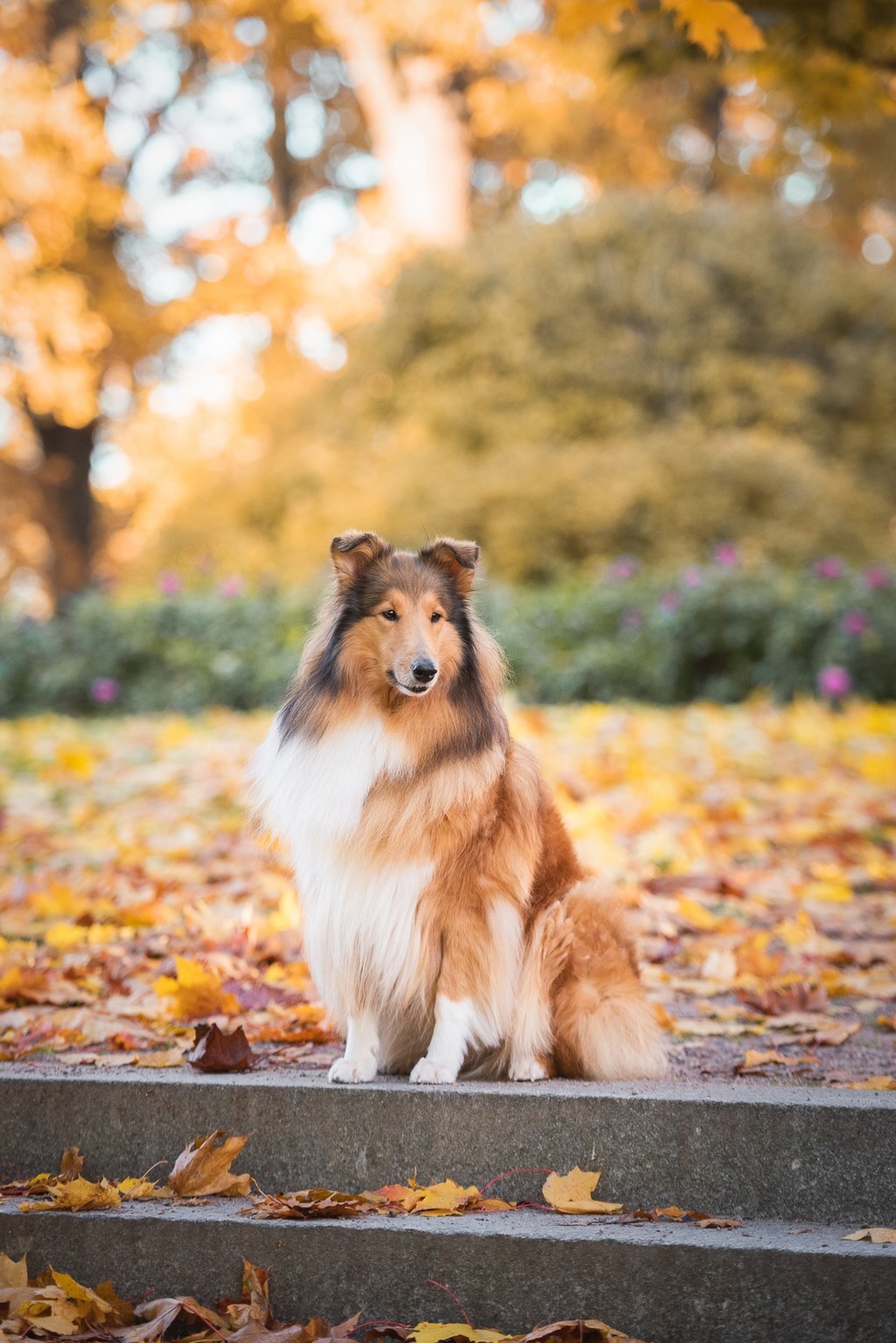
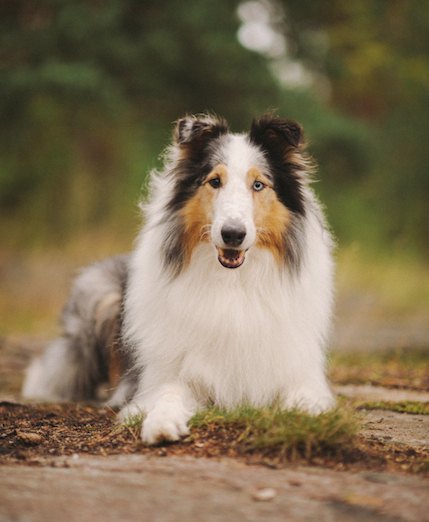

The Rough Collie's expression is an important part of the whole.
NECK
Muscular, powerful, of fair length and well arched.
BODY
Slightly long compared to its height.
Back: Firm.
Loin: Slightly arched.
Chest: Ribs well sprung, chest deep and fairly broad behind the shoulders.
TAIL
Long; the tail bone reaches at least to the hock. Carried low when the dog is quiet, with the tip slightly turned up. When the dog is excited the tail may be raised, but never over the back.
LIMBS
Forequarters: Shoulders: Sloping and well angulated. Elbows: Turned neither in nor out. Forearms: Straight and muscular; bone of moderate strength and round. Front feet: Oval; pads well padded. Toes arched and close together.
Hindquarters: Thighs: Muscular. Stifles: Well angulated. Lower thighs: Clean and sinewy. Hocks: Well let down and powerful. Hind feet: Oval; pads well padded. Toes close together but not quite as arched as in the front feet.
GAIT / MOVEMENT
Movement is a distinctive characteristic of the breed. A sound dog never moves out at the elbows, yet the forelegs travel comparatively close together. Plaiting, crossing or rolling movement is a serious fault. Seen from behind, the hind legs are parallel but not too close together; seen from the side, the action is smooth. The hind legs are powerful with plenty of drive. A reasonably long stride is desirable; it should be light and appear effortless. It is extremely important that the dog's movement is balanced in every respect.
COAT
Hair: The very dense coat fits the outline of the body. The outer coat is straight and harsh to the touch; the undercoat is soft, furry and very close, almost hiding the skin. The mane and frill are very abundant, the mask or face smooth, the ear tips smooth but more heavily coated at the base. The forelegs are well feathered, and the hind legs above the hocks carry profuse breeching. Below the hocks the hair is short. The tail is very profusely coated.
Colour: Sable, tricolour and blue merle.
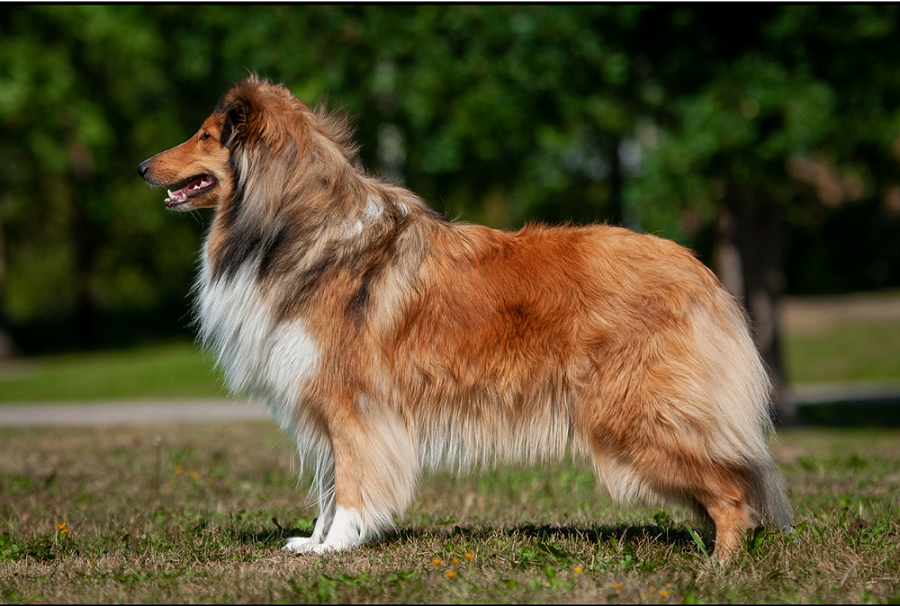
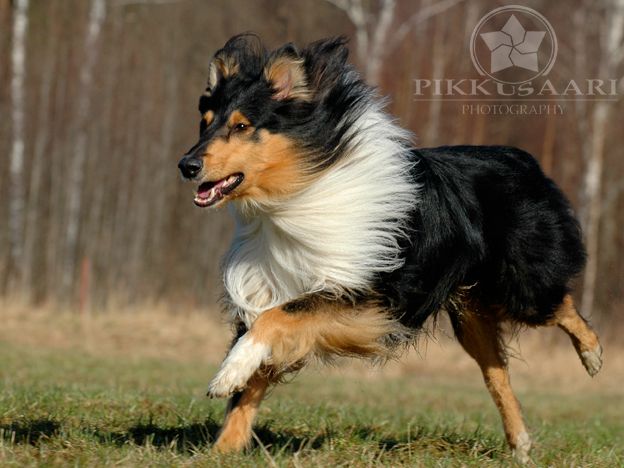
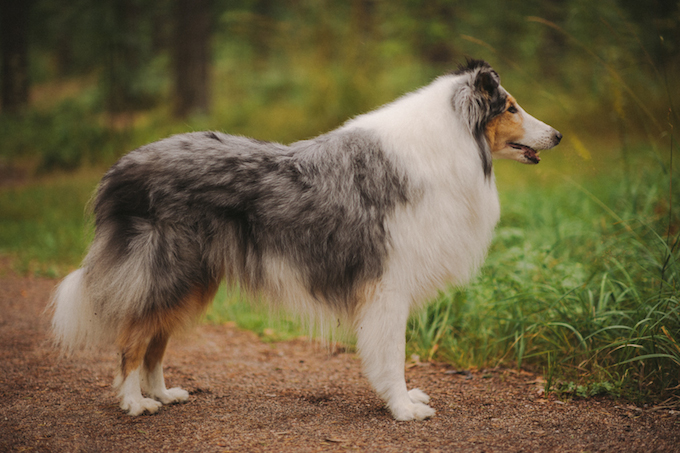
Rough Collie colours: sable, tricolour and blue merle.
Sable: Any shade from light gold to rich mahogany, or shaded sable. Light straw or cream colour is a serious fault.
Tricolour: Predominantly black, with rich tan markings on the legs and head. A rusty tinge in the top coat is a serious fault.
Blue merle: Predominantly clear, silvery blue, splashed and marbled with black. Rich tan markings are preferred, but their absence is not a fault. Large black markings, a slate colour or a rusty tinge in either the top coat or undercoat are serious faults.
White markings: All the colours above may carry the typical white collie markings to a greater or lesser degree. The following markings are favourable: a full or part white collar, white shirt, legs and feet, and a white tail tip. A blaze may be carried on the muzzle, skull or both. All-white or predominantly white colouring is a serious fault.
SIZE
Height at the withers: Males 56–61 cm, females 51–56 cm.
FAULTS
Any departure from the foregoing points is considered a fault, and the seriousness with which the fault is regarded should be in exact proportion to its degree and its effect upon the health and welfare of the dog and its ability to perform its traditional work.
DISQUALIFYING FAULTS
Aggressive or overly shy
Clearly abnormal structure or behaviour
NB: Male animals should have two apparently normal testicles fully descended into the scrotum.
Only functionally and clinically healthy dogs with breed-typical conformation should be used for breeding.
More about the breed elsewhere
Rough Collie breed profile on Hankikoira.fi
Rough Collie | Hankikoira (in Finnish)
Breeding strategy
Breeding strategy (JTO): Rough Collie 2019–2023 (in Finnish)
Breed club website
Finnish Collie Club – Suomen Collieyhdistys ry / Finlands Collieförening rf (scy.fi)
On Riemumielen's dog blog (in Finnish)
The Rough Collie as a sporting dog
What does the breed standard say about the collie's temperament?
Five myths about collies
Is a collie right for me? A short course
Why is my breed the Rough Collie?
Collie breed presentations on video
Eija Granfelt presents the Rough Collie breed on video for Lemmikkimedia (in Finnish).